
Daniela Mattson is a journalism and documentary student at USC who focuses on social justice issues and the Latino community. This piece is part of "Resilience in the Age of ICE," a series of podcasts and essays produced by students in the USC Annenberg School for Communication and Journalism and published by Golden State. The complete series can be found here.
Susan Ferguson, a 53-year-old woman and high school teacher, sat in her car in neighborhood parking lot on a hot summer day in June 2025 in San Pedro, searching for the people who had been terrorizing her neighbors.
She put her car in drive, then proceeded to drive past car washes, Home Depots, small businesses and parks, vigilant for any sign of the United States Immigration and Customs Enforcement or the Border Patrol. Whenever she saw their activity, she took a photo with her phone and posted it on the Harbor Area Peace Patrols' (HAPP) Instagram page, marking the date, time and location. If there were no sightings, she would take a photo of the location, post it on the same Instagram page, and determine it as a “clear” site, safe from any ICE activity.
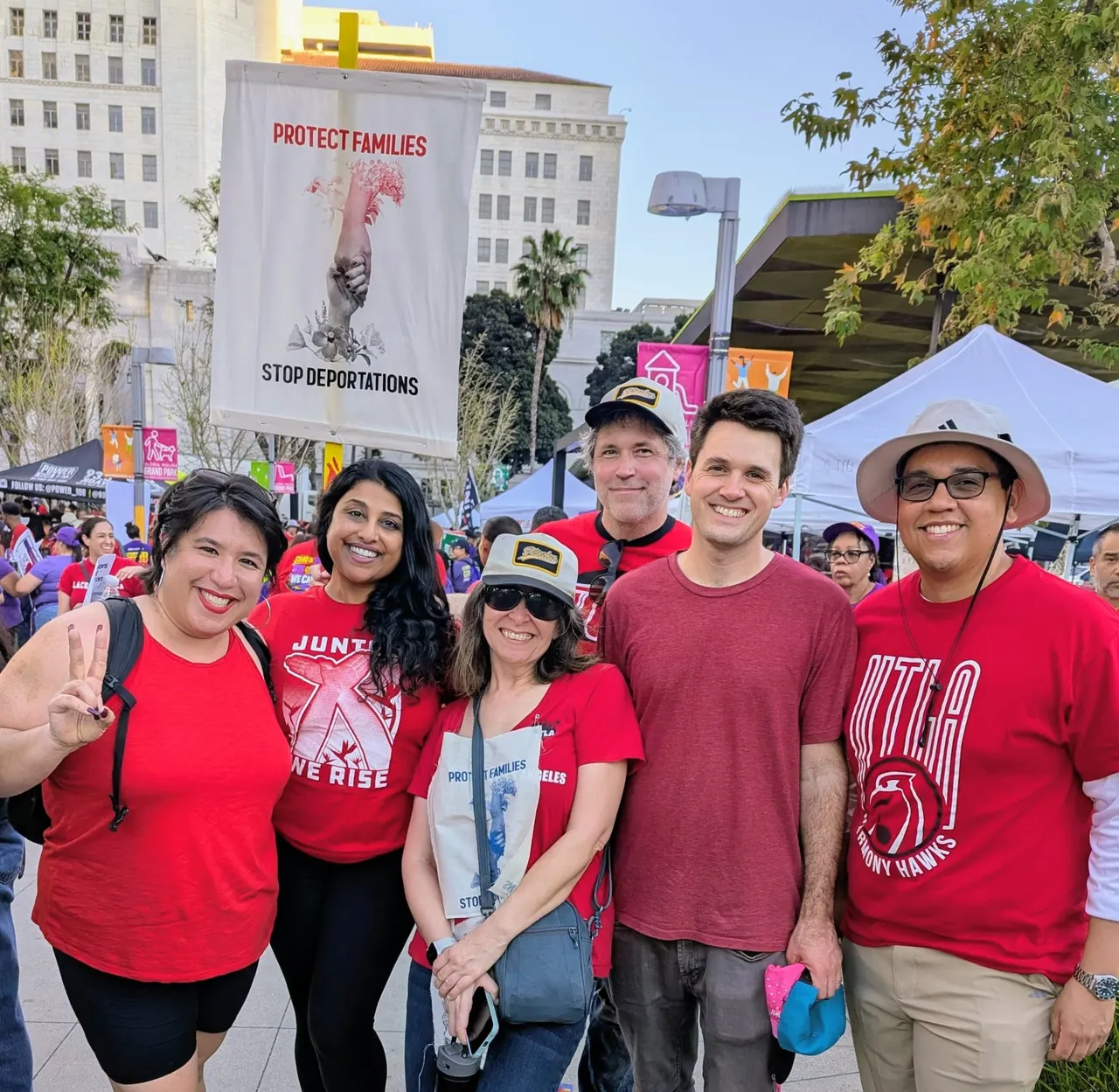
This is how she spent nearly every day of her time off from teaching during summer break: patrolling for the teacher-founded advocacy group HAPP, one of several patrol groups across Los Angeles made up of community members, many of whom are educators who seek to protect their communities from ICE.
“Patrolling was a way that I could exert some control and feel like I was doing something amidst all of the chaos and feeling that my community was being torn apart,” Ferguson said.
 Guest Contributors
In recent months, President Trump and his allies have increasingly characterized immigration advocates, legal observers and protest groups as “domestic terrorists” or threats to public order — rhetoric that has helped justify a broader crackdown on dissent.
But the educators driving through Los Angeles neighborhoods for groups like HAPP present a starkly different image: teachers and paraprofessionals trying to support the frightened members of their communities. Rather than masking their identities or operating in secrecy, many do their work proudly and openly, describing their patrols as an extension of the care work they already perform in classrooms every day.
Ferguson is not the “domestic terrorist” that Trump and his allies have been conjuring when describing grassroots immigration advocates. With her wispy grey hair, glasses and a friendly smile, she represents the vast majority of those involved in these types of groups.
Despite long work hours, rising gas prices and inflation, taking time to patrol for ICE in their communities is a sacrifice educators are willing to make. Ferguson said her activism hasn’t cost her much money and is a way for her to connect with her community, calling it “priceless.”
Feguson first joined HAPP last year after one of the group’s co-founders, Maya Suzuki-Daniels, a coworker at her school, invited her to a meeting. She felt compelled to do something about the fear ICE was instilling in her community; as a long-time teacher at San Pedro High School, she has grown to care deeply about her diverse neighbors. After that initial meeting, she decided to join the ranks. She has not looked back.
Trump’s second term has been characterized by mass deportations and ICE raids targeting worksites and public spaces, causing many people to feel unsafe leaving their homes, taking their children to school or visiting the grocery store. In a summer marked by this type of fear and paralysis, Los Angeles teachers were among those who mobilized to let families in their communities know when it’s safe to move around.

Just $33.33. It's less than a tank of gas or a bag of groceries. But that's all it would take from each of our readers to keep Golden State going through 2026.
HAPP has patrols active every day to inform people of when certain areas in San Pedro, Wilmington and the Port of Los Angeles are “clear” of ICE presence. They post community alerts on their Instagram, indicating which areas have been patrolled and determined to be clear of ICE. Their goal is to help neighbors, especially immigrants, know when it is safe to be active in certain areas in the community so they’re not trapped at home.
During the school year, Ferguson commits to patrolling two days a week and is the lead patroller while on shift. It’s emotionally taxing work, but she does it for the people she knows are more vulnerable than her, such as her students, whose suffering she sees firsthand.
“The anxiety caused by this and the fear has definitely impacted student learning, the fear of not having a place to live because your family members can’t go to work, because they’re afraid they will be kidnapped,” Ferguson said. “Almost everyone I know has had to cope because of this trauma that has been inflicted on our community.”
According to a Los Angeles Times article published late last year, 70% of public high school principals in the L.A. Unified School District said their students from immigrant families expressed fear for themselves or family members because of the increase in immigration enforcement. LA Public Press reported that the district saw a 4% decrease in enrollment in the 2025-26 academic year.
For those who remain in school, their ability to engage in learning is hindered by fears of ICE.
“Those who stay enrolled, but hear about ICE presence in their neighborhood on the way to school, might choose to stay home for the day,” Tanya Ortiz Franklin, L.A. Unified board member for District 7, said. “If there was a raid in their community the night before, they’re struggling with the social, emotional impacts of that, and so they stay home.”
The district has responded to this by providing transportation to school for students, as well as several programs and workshops to inform families about their rights.
 Katherine Contreras Hernandez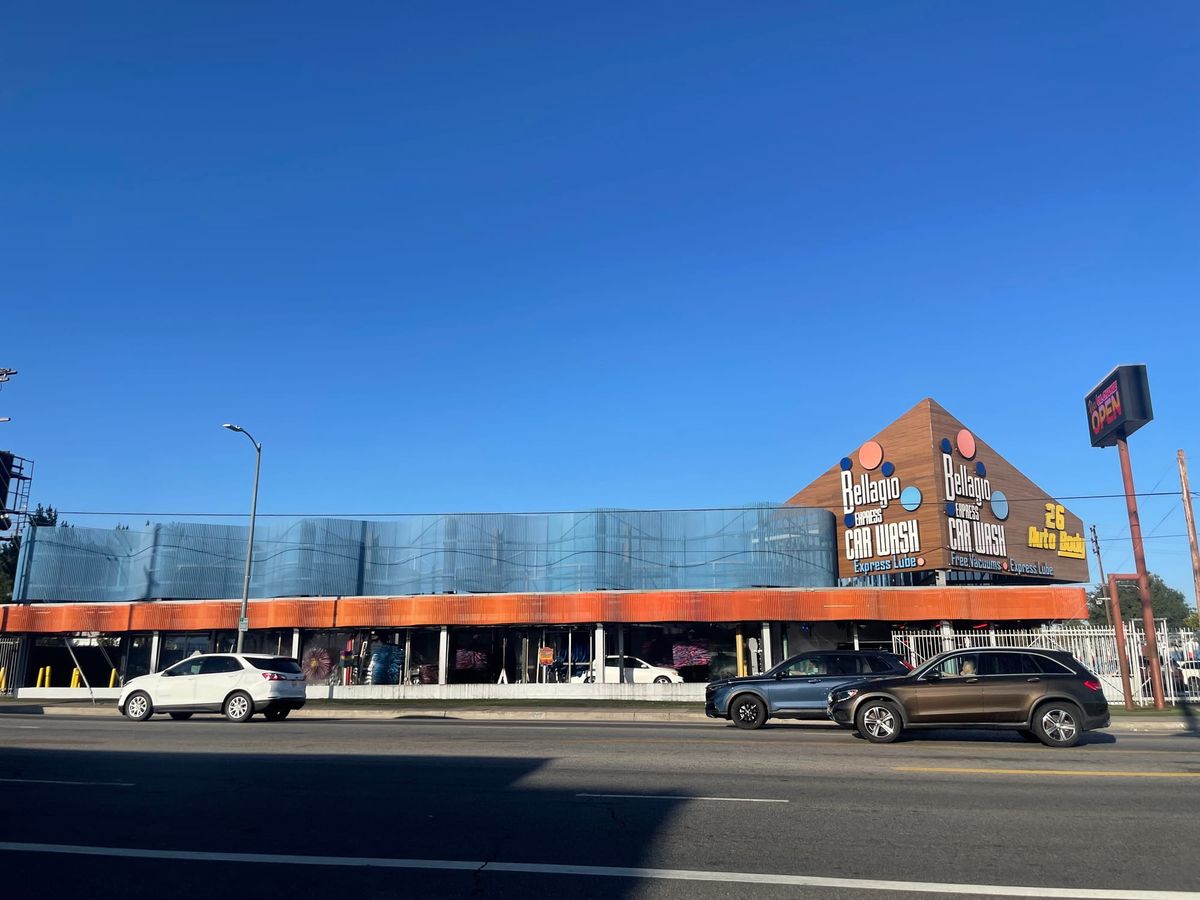
Kelly Gonez, the L.A. Unified board member for District 6, added that the school district has been working to bring resources to impacted families.
“We’ve also expanded mental health supports, food distribution partnerships, our counseling teams are regularly connecting with the families we know that are most at risk or that have been directly impacted by raids or abductions of their family members, and they are providing direct connections to services,” Gonez said.
Franklin said the district also provides resources for teachers on how to navigate the emotional stressors many of their students are feeling.
“Even more important is the training on how to deal with the constant trauma and heaviness that our students, staff, and families are experiencing,” Franklin said. “Folks are really being trained on how to hold space for that and help students process.”
Gonez has been working with United Teachers Los Angeles, the main trade union for certified, non-administrative staff in the L.A. Unified School District, to connect educators with district human resources that provide information and one-to-one consultations regarding anxiety and safety.
The resources and consultations are directed towards educators who are concerned about their own safety and want support for how to best protect themselves and their families. The district is also working to provide legal support for teachers who may be DACA recipients, have temporary immigration status or are legal permanent residents.
Educators like Ferguson want their students to feel supported. She said she appreciates how supportive the HAPP community has been to educators, in turn, giving them the ability to be involved as much or as little as they can.
“If we’re not taking care of ourselves, how can we begin to take care of other people?” Ferguson said. “I really believe that as a parent [of an elementary-aged son] and as a teacher.”
Some educators who are UTLA members themselves are involved in neighborhood patrol groups, and work within the union to organize workshops for teachers on handling ICE in schools.
 Jon Regardie
When UTLA representative Scott Mandel hears of ICE in the neighborhood or near his school, he notifies the Rapid Response Network team in his neighborhood by phone, and they gather patrollers to send them to areas where ICE has been spotted.
Mandel teaches media and performing arts and 6th-grade gifted English history at Pacoima Middle School. He represents the Valley East area and the eastern San Fernando Valley for UTLA. The majority of his day is spent in the classroom, so he does what he can to communicate with his community about ICE sightings.
He has seen the emotional toll anti-immigrant policies have had on his students firsthand. More than half of the 6th graders he has spoken to about the impact of ICE raids on their daily lives said they avoid public areas, such as parks.
“It’s more than just families being broken over fear of ICE. It’s [also] psychologically what it’s doing to our kids, especially younger kids,” Mandel said.
Seeing the impact is what motivates educators like Mandel to lead rapid response work.
When Trump entered his second term, Mandel asked Jorge Boche, who has worked in education for over 20 years, if he would be interested in taking charge of the Valley East Rapid Response Network as a lead organizer. Boche met Mandel when he asked if UTLA was planning on taking action on immigration issues in the Valley East.
Boche is now the UTLA Chapter Chair at MacClary Middle School and lead for the Valley East Rapid Response Network. He began working as a paraprofessional at 18 years old.
He joined the rapid response team to empower the community and keep them safe. He said he believes in teaching people their rights and showing students how to empower their parents and families.
“I’ve always been a person of social justice and helping out the community,” Boche said. “Working and helping out the community in this way was very important because we have to be the voice for the voiceless.”
Despite being in a classroom most of the day, like Mandel, Boche patrols on his way to work, and when he takes his daughter to school, he is ready to alert his community. Boche hopes that, in addition to being vigilant for ICE, he can be a resource for families who are afraid.
He directs his students to resources, including food assistance programs that deliver food to families affected by ICE, and communicates that he is available to listen to concerns or fears his students have.
Educators are not the only ones who have openly joined resistance in schools and communities. Students across Los Angeles have participated in walkouts and protests to demand protection for their communities.
 José M. Alamillo
Advocacy and protests at Los Angeles schools have been occurring since January 2025, with the fear of ICE entering schools becoming more prominent since then. Students have organized school walkouts in protest of ICE, including on Feb. 6, when 12,500 students from 85 LA Unified schools participated in walkouts across Pasadena, Orange County and the San Gabriel Valley.
The work of educators protecting their communities extends beyond looking out for ICE near their schools. Mandel and Boche understand the importance of helping their students understand the current threat posed by immigration enforcement, and of empowering them to feel safe in the classroom and learn the importance of advocacy.
Boche said his students know his classroom is a safe space, and he prioritizes daily check-ins to discuss the issues they care about. He has also seen more students take charge in advocacy by creating social justice clubs at his school.
“It’s beautiful to see kids empowering other students and empowering themselves,” Boche said. “That’s where real education comes in, where students are using their knowledge at school to be contributors in their community.”
Mandel focuses on fostering positive relationships with his students so they feel comfortable addressing their concerns with him.
“Kids know I’m there for them. They’re more open to relax … and they can learn,” Mandel said.
Boche feels the same way and teaches his students how to identify problems while recognizing their own agency.
“When we identify a problem, we need to act together to solve them, either by taking to the streets as in organizing, as in marching, and most definitely using their voices for change,” Boche said. “That’s how, as a teacher, I try to educate and empower these students to use their voice effectively.”
Whether they are driving cars and patrolling the streets at early hours, or being the support for their students who feel anxious and unsure about their family’s safety, educators remain involved in their communities beyond class time.
“We’re doing what we can. We’re taking care of our kids,” Mandel said. “We’re taking care of our families, and that means fighting this whatever way possible–fighting at the ballot box, fighting in rallies, providing materials for our parents, our families, and being there for them.”
During the school year, Ferguson continues to patrol two days per week and report ICE sightings to the HAPP Instagram account. She hopes that by being a patroller, she can model her civic responsibility and make a difference for her students. And perhaps her resistance can even help change public opinion about the raids.
“These are our community members, and these are not criminals,” Ferguson said. “These are people that are our neighbors and that we love and care about, who are just trying to survive and make a better life for themselves. It impacts all of us.”


